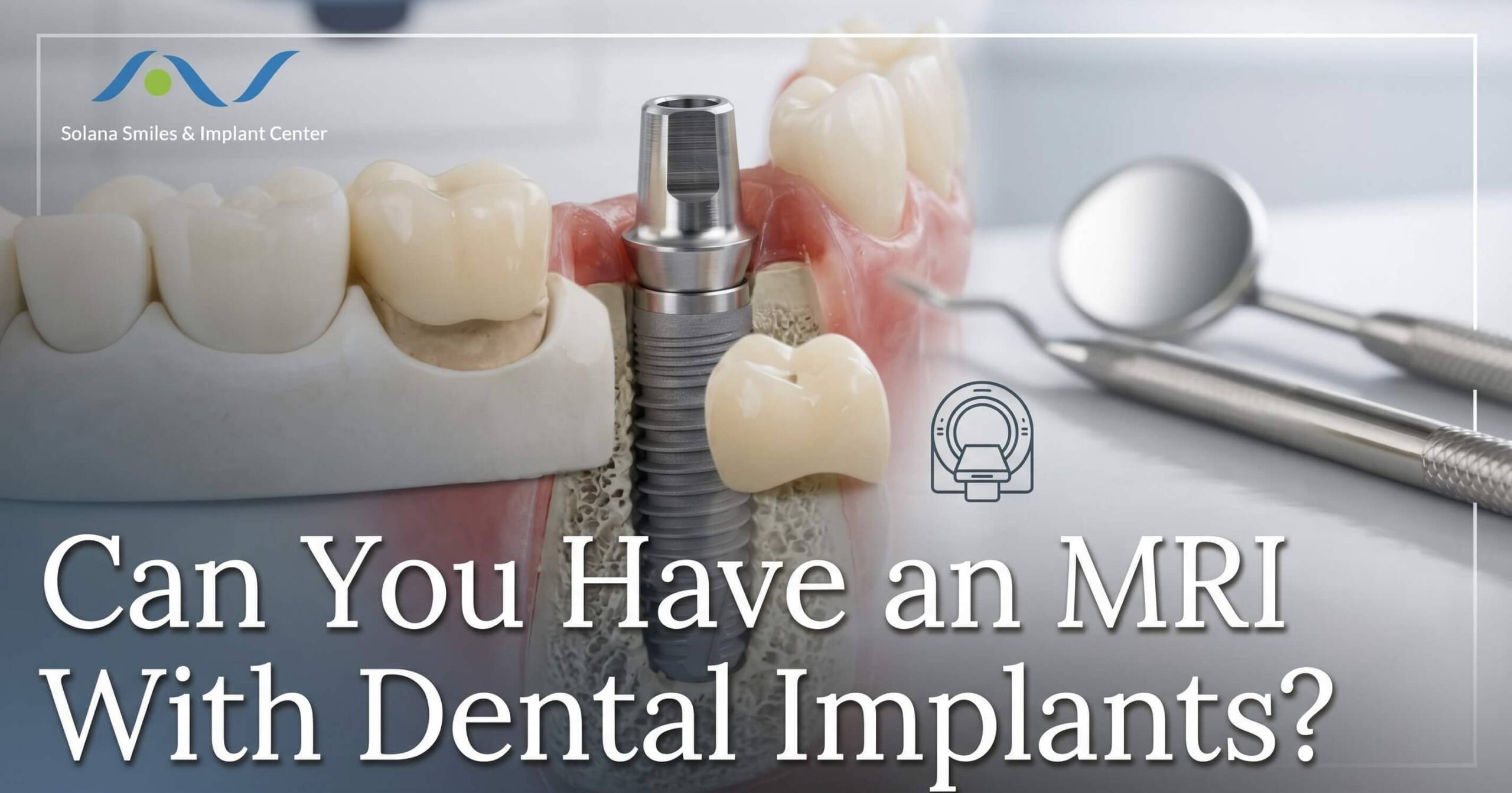
If you have an upcoming scan and a mouth full of dental work, it is completely normal to pause and wonder: can you have an MRI with dental implants?
In most cases, yes. Most modern dental implants are considered MRI safe, and patients can undergo MRI scans without a problem. The reason is simple: most dental implants are made from titanium or zirconia, which are non magnetic or only minimally reactive in the presence of the strong magnetic fields used during magnetic resonance imaging.
That said, there is an important difference between “safe” and “invisible.” While modern dental implants usually do not move, heat up, or become dangerous in the MRI machine, some types of metal dental work can affect image quality. In certain situations, implants, dental crowns, metal fillings, or metal clasps on removable dentures may create small artifacts on the scan. Those distortions matter most when the imaging is focused near the face, jaw area, sinuses, or brain.
For patients in Solana Beach, Poway, and the greater San Diego area, this is one of those questions that sounds scary until you get a clear answer. The short version is reassuring: MRI with dental implants is usually safe, but your doctor, dentist, and MRI technician should know exactly what dental work you have before the procedure.
Why dental implants are usually compatible with MRI scans
MRI uses a powerful magnet along with radio waves to create detailed images of soft tissues inside the body. Because the MRI machine relies on magnetic fields, people often assume any metal in the body is automatically dangerous. That is not how it works.
The real issue is what kind of metal is present. Ferromagnetic metals are strongly attracted to magnets. Ferromagnetic materials can shift, twist, or interfere more significantly during MRI imaging. Unlike ferromagnetic metals, titanium dental implants and zirconia implants are generally non magnetic or only weakly magnetic. That is why most dental implants are considered MRI safe.
Modern dental implants are designed with both function and biocompatibility in mind. Titanium is widely used because it integrates well with bone, stays firmly anchored at the implant site, and does not behave like the kinds of metal implants that raise major MRI safety concerns. Zirconia implants are also increasingly used in modern dentistry and are likewise viewed as mri compatible.
In other words, the implant itself is usually not the problem. The bigger question is whether surrounding dental work may interfere with the scan or the clarity of the final images.
What most dental implants are made of
Most dental implants today are made from titanium implants or zirconia implants. Titanium dental implants are especially common because titanium is strong, durable, lightweight, and biocompatible. Many systems use titanium alloys, which maintain those same practical benefits while supporting long-term stability.
Because titanium is non magnetic, it does not react to the MRI machine the way ferromagnetic metals do. That is why most dental implants stay firmly in place during mri scans. They do not get yanked around by the powerful magnet, and they do not pose the kind of movement risk people imagine.
Modern implants may also include attached restorations like dental crowns, abutments, or bridges. Depending on the materials used, these components may contain some metal content. In some cases, metal crowns or other metal dental work can create small artifacts on mri imaging, even when the implant post itself is not an issue.
This is why it helps to think of MRI with dental implants as a materials question, not just an implant question. The implant may be perfectly mri safe, while a nearby restoration could still affect image quality.
Can dental implants interfere with MRI imaging?
Yes, but usually in a limited way. When people ask whether dental implants interfere with MRI, they are often asking two separate questions: is it safe, and will it ruin the scan?
Safety and image quality are not the same thing. Most modern dental implants are safe in an MRI machine. However, dental implants interfere with imaging sometimes by causing image artifacts, signal voids, or minor artifacts near the mouth and face. These distortions can create blurry zones or shadowed areas that make interpretation harder.
This matters most when the scan is focused on the head or neck. If your doctor orders mri scans of the knee, spine, hip, or abdomen, dental implants are very unlikely to affect the mri results in any meaningful way. But if the scan is of the brain, jaw area, sinuses, temporomandibular joints, or nearby soft tissue, metal dental work can sometimes interfere enough to require adjusted imaging sequences.
Even then, modern mri machines and updated scan settings often help reduce the impact. Experienced radiology teams know how to work around common dental artifacts. In many cases, they can still get an accurate diagnosis despite existing implants.
When MRI with dental implants may affect the scan
The closer the area being imaged is to the mouth, the more likely it is that metal can create small artifacts. Think of it like trying to photograph a landscape through a window with a smudge in one corner. If the smudge is nowhere near your subject, it barely matters. If it sits right over the thing you need to see, then it becomes a problem.
That is why mri with dental implants may be more relevant for a brain scan, facial imaging, sinus evaluation, or TMJ assessment than for a lower back study. If your doctor is evaluating a structure near the implant site, the radiologist may want implant documentation or more implant details ahead of time.
Some dental work is more likely than others to interfere. Metal crowns, metal fillings, older bridges, orthodontic hardware, and metal clasps on removable dentures can all contribute to image artifacts. Removable dentures are often taken out before the scan. Fixed implants and restorations usually stay in place.
In rare cases, if artifacts prevent accurate diagnosis, your doctor may order ct scans or another type of imaging instead. CT scans and x rays can be useful alternatives when MRI results are compromised near the mouth or brain.
What to tell the MRI technician before your scan
Before any MRI procedure, always tell the MRI technician and your doctor about your dental implants and any other dental work. Do not assume it is too minor to mention. Even if your implants are considered mri safe, the imaging team still needs a full picture.
Helpful details include when your implants were placed, whether they are titanium implants or zirconia implants, whether you have attached dental crowns or bridges, and whether you wear removable dentures with metal clasps. If you have implant documentation from your dentist, bring it with you. That paperwork can help the radiology team confirm the materials used and determine whether any adjustments are needed.
This is especially important if you have multiple existing implants, full-arch restorations, or complex reconstructive dental work. Patients who have undergone dental implant treatment or more advanced tooth replacement may have several components in place, and the more complete the implant details, the easier it is for the imaging team to plan.
A good rule is simple: if it is in your mouth and not natural tooth structure, mention it.
Are titanium and zirconia both MRI safe?
Yes, in general both are mri compatible. Titanium and zirconia are common materials in modern implants, and both are widely regarded as safe for MRI imaging.
Titanium implants are the standard choice in many practices because they are durable and biocompatible. Titanium dental implants are also non magnetic, which is why they are generally considered mri safe. Zirconia implants are ceramic rather than metal, and they are also non magnetic materials, making them another favorable option for patients concerned about MRI safety.
Unlike ferromagnetic metals, these materials do not respond aggressively to strong magnetic fields. That is the key distinction. The concern with metal implants in MRI is not merely that they contain metal, but whether that metal is ferromagnetic. Titanium implants and zirconia implants do not behave like iron-based or other strongly magnetic substances.
So if your question is can you have an mri with dental implants made of titanium or zirconia, the answer is usually yes. The finer point is whether surrounding restorations may affect the scan.
What about crowns, fillings, dentures, and other dental work?
Dental implants are only one part of the picture. Many patients also have dental crowns, metal fillings, bridges, retainers, or removable dentures. These materials may not make MRI unsafe, but they can sometimes interfere with mri imaging.
Metal crowns and older restorations can create image artifacts, especially during mri scans of the brain or face. Metal fillings may also cause small artifacts. Removable dentures should usually be removed before the scan, particularly if they contain metal clasps. The same goes for any removable oral appliance unless the MRI technician tells you otherwise.
This does not mean your scan cannot happen. It simply means the radiology team should know what is present. In many cases, they can modify imaging sequences, change positioning, or adjust scan settings to improve image quality.
If you are considering implant-supported restoration and want to understand how different options compare over time, it can also help to learn about implant-supported tooth replacement options. The materials used in modern dentistry are chosen not only for appearance and strength, but also for long-term function and compatibility with medical care.
What if an implant feels loose before the MRI?
If an implant feels loose, tell your dentist before the scan. A stable implant is expected to remain secure, but if an implant feels loose, that is a separate dental issue that deserves prompt evaluation.
A loose implant does not automatically mean the MRI is unsafe, but it changes the conversation. The problem may involve the crown, abutment, surrounding bone, or the implant itself. Your doctor and dentist may want to assess the implant site first, especially if you are having symptoms like pain, swelling, or biting discomfort.
This is one reason regular follow-up matters after placement. Patients with existing implants should continue routine exams so any problems are caught early. If you are overdue, scheduling a routine dental exam and checkup can help confirm that your implants and restorations are stable.
Why newer implant systems are less concerning than many people think
A lot of anxiety around mri with dental comes from outdated assumptions. Years ago, people heard “metal” and “magnet” in the same sentence and pictured a disaster movie. But modern dentistry has changed. Modern dental implants and modern implants are made from materials selected specifically for safety, durability, and compatibility with everyday life.
That includes compatibility with medical imaging. Most dental implants inform the MRI process only in the sense that they should be disclosed, not because they create a serious hazard. Modern mri machines are also better than older systems at managing artifact issues and producing detailed images despite nearby dental materials.
There are still rare cases where image artifacts can prevent accurate diagnosis, particularly when the area of concern is close to the mouth or brain. But that is a planning issue, not usually a safety emergency. In those moments, healthcare providers may recommend ct scans or another approach.
Practical tips before your appointment
If you are scheduled for MRI with dental implants, keep the prep simple. Tell the imaging center exactly what dental work you have. Bring implant documentation if you have it. Remove any removable dentures, aligners, retainers, or appliances unless you are told otherwise.
If you know the brand or material of your implants, share that information. If you do not know, your dentist may be able to provide implant details quickly. This is especially useful for patients with full-arch restorations, multiple implants, or extensive dental work.
Also tell your doctor if your scan is for the brain, jaw, or sinus region. That helps everyone focus on whether artifacts could affect mri results. Most of the time, the process moves forward without major changes.
The bottom line
So, can you have an mri with dental implants? In most cases, yes.
Most dental implants are made from titanium or zirconia, both of which are generally non magnetic and considered mri safe. They do not behave like ferromagnetic metals in the presence of strong magnetic fields, and they usually do not create a safety problem in the mri machine.
What they can do, along with other metal dental work, is create minor artifacts or signal voids that may interfere with image quality when the scan is focused near the mouth, face, or brain. That is why communication matters. Tell your doctor, your dentist, and the MRI technician about your implants, restorations, dentures, and any other dental work before the procedure.
For most patients, MRI with dental implants is not a red flag. It is just one more detail your care team needs in order to get the clearest, safest scan possible.